Control stations
2049 Diósd, Sashegyi köz 1.
1152 Budapest, Beller Imre Street 2.
Availability
+36 70 949 0106
bysofi.kozmetika@gmail.com

Control stations
2049 Diósd, Sashegyi köz 1.
1152 Budapest, Beller Imre Street 2.
Availability
+36 70 949 0106
bysofi.kozmetika@gmail.com
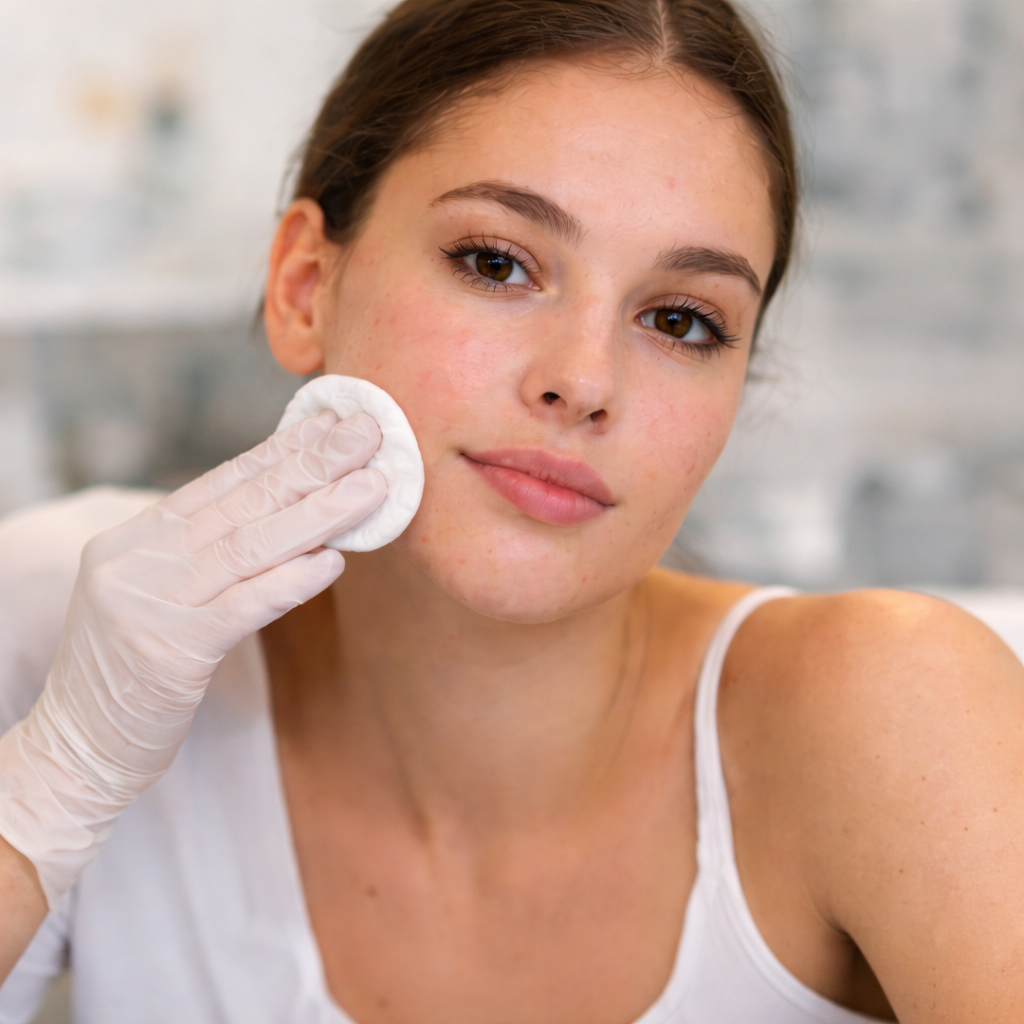
If you have acne-prone skin, you have probably already tried all kinds of products: strong cleansers, drying spot treatments—sometimes three of them one after another. Experience shows, however, that acne-prone skin does not calm down when you treat it more aggressively. It improves when you care for it gently and consistently. A home skincare routine cannot replace working with a professional, but between treatments, you—not your beautician—are the one caring for your skin every day.
I have put together what is worth doing at home and what is best avoided. I have deliberately left out specific product names: there is no single tube of cream that works for everyone—only an approach that delivers results in the long term.
Acne is not caused by poor hygiene, and it does not appear because you “do not wash your face enough”. Several factors are involved at the same time: sebum production, clogged pores, the balance of the skin’s microbiome and inflammatory processes. Hormones, stress, sleep quality and the products you use on your skin during the day also play a role.
Two important conclusions follow from this. Firstly, excessive cleansing and drying achieve the exact opposite of what you want—a damaged skin barrier can lead to increased sebum production and more inflammation. Secondly, genuine improvement takes time and is usually measured in weeks rather than days. A gradual approach is not the slow option here; it is the most direct route.
An effective acne routine is surprisingly simple. Its success does not depend on how many products you line up on your shelf, but on following the same routine consistently every day.
Always introduce a new active ingredient gradually: start two or three times a week and only increase the frequency if your skin tolerates it without irritation. Stinging, burning, redness and peeling do not mean that the product is “starting to work”—they are signs of irritation.
There is no miracle diet, and no one is claiming that acne will disappear simply because you stop eating one particular food. However, many people notice that irregular sleep, prolonged stress and fluctuating blood sugar levels coincide with periods when their skin becomes worse. It is worth observing your own patterns: when your skin becomes irritated, when it calms down and what was happening around that time.
A simple way to do this is to keep a skin diary. A few lines each week are enough: what products you used, how you slept and what happened to your skin. After a few weeks, you will begin to notice the connections yourself—and your beautician can work with this information far more effectively than with the answer, “Well, sometimes it gets worse.”
Home skincare has its limits. Consult a professional if painful, deep-seated lumps appear, if you notice scarring, if the changes spread rapidly, or if several months of consistent skincare produce no improvement. In cases of severe inflammation, when prescription treatment may be needed, or if your skin suddenly deteriorates without an obvious reason, a dermatologist should be your first point of contact. A beautician cannot provide a medical diagnosis and does not replace a medical examination.
The two approaches complement each other well. A thorough skin assessment shows what you are actually dealing with, allowing your home routine to become targeted rather than based on guesswork.
At my salon, treatments for problematic and sensitive skin are available as a dedicated service. They are suitable for acne-prone and sensitive skin and may include precision needle pore cleansing tailored to your skin’s individual tolerance. soft lézer terápia When soothing the skin and reducing inflammation are the main priorities, soft laser therapy can also provide effective support. This is a gentle, pain-free treatment using blue, red and infrared light.
It is important to note that soft laser therapy is not suitable for everyone. It is not recommended during pregnancy, for people with thyroid disease or cancer, or on fungal or infected skin. We will always discuss this during the consultation. ingyenes, kötelezettségmentes konzultációt — semmire nem kötelez, viszont sokkal tisztább képet ad, mint bármelyik online tanács. Ha pedig már tudod, mit szeretnél, foglalj időpontot itt.
Your skin did not become this way overnight, and it will not calm down overnight either. But when you treat it patiently and consistently, it will begin to work with you.